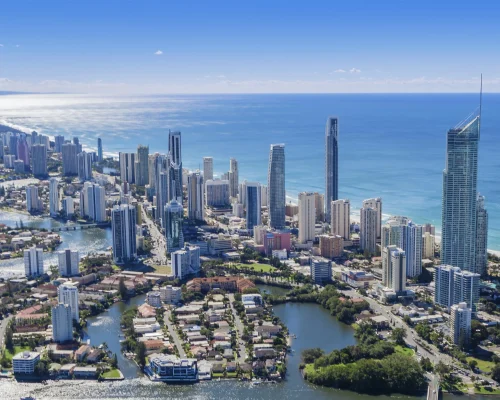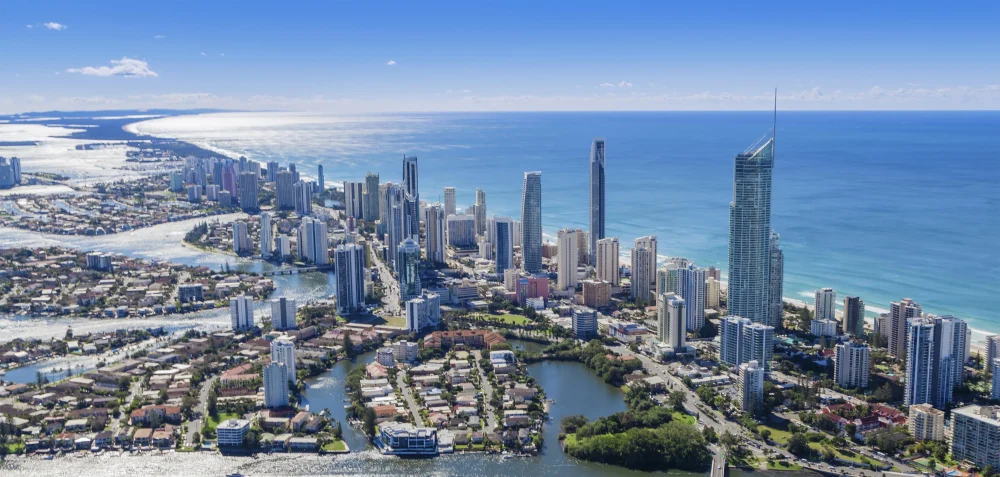

The Gold Coast (Property Market) has had an extraordinary run. After years of being written off as a cyclical holiday market prone to boom-bust swings, it has fundamentally changed its stripes. Five years of relentless population growth, a wave of high-wealth (interstate) migrants from Sydney and Melbourne, and a chronic shortage of new homes have transformed the Gold Coast into one of Australia’s most compelling property markets for 2026 and beyond.
According to Dominic Cavagnino, head of research at Binnari Property, the Gold Coast market has performed exceptionally well, delivering growth near the 5-10% mark over the last 12 months. This comes on top of an already strong performance during the COVID years, when the market experienced dramatic price increases as remote workers discovered they could live in paradise while maintaining their careers.
The numbers back that up. According to Ray White data, the city’s median unit price reached $956,000 as of October 2025, overtaking Sydney’s $927,000 for the first time in history, a 101% increase over 10 years. Median house prices now sit at $1.32 million city wide, with certain pockets pushing well past that. As Ray White Chief Economist Nerida Conisbee puts it, the Gold Coast is simply no longer an affordable coastal alternative.
So what does 2026 look like? Here’s our breakdown.

How Much Will Gold Coast Property Prices Grow in 2026?
SQM Research is forecasting dwelling price growth of between 7% and 11% for 2026. Bamboo Routes is even more bullish, tipping growth of up to 13%. The consensus across forecasters is that supply will continue to lag demand, vacancy rates will remain compressed, and the infrastructure tailwinds from the 2032 Olympics will sustain momentum well past this year.
Growth throughout 2025 came in around 8.5% across the broader market, though individual suburbs outperformed significantly, Molendinar’s unit segment gained 18.1%, Miami units climbed 13.3%, and Pimpama houses rose 12.1%. For 2026, expect similar variance: the best-positioned suburbs will outperform the headline number, and the wrong end of the market, particularly oversupplied luxury whole-floor apartments, will lag.
The apartment story deserves special mention. With median house prices now above $1.3 million, buyers who can’t stretch to a house are targeting units aggressively, and there simply isn’t enough supply to meet that demand. The development pipeline has shifted, developers now build predominantly two and three-bedroom, owner-occupier style apartments with larger floor plates rather than the one-bedroom investor product that used to dominate the Gold Coast market. That evolution has reduced the risk of oversupply at the mainstream level, and PropTrack data supports the view that well-located Gold Coast units will be among the standout performers nationally in 2026.
For investors eyeing off-the-plan purchases specifically, which is where much of the quality new stock is being sold, it’s worth noting that settlement on these projects can sit 12 to 24 months away. That’s a long time to have a large cash deposit sitting idle while the market continues to move. A deposit bond solves that problem by securing your position at exchange without locking away your capital, which in a market forecast to grow 7-11% this year, is a meaningful advantage. ENAYBL specialises in exactly this, reach out if you’re working through the numbers on an off-the-plan purchase.
What's Driving Gold Coast Property Growth?
Several structural forces are converging on the Gold Coast simultaneously, and understanding them matters more than any single data point.

Population that keeps arriving
The Gold Coast added over 15,000 new residents in 2024 alone, driven by interstate migration from New South Wales and Victoria. What’s notable about this wave is the demographic. This isn’t people priced out of Sydney, it’s high-income earners, business owners, and families who have chosen lifestyle deliberately. Many arrived during the pandemic expecting to stay temporarily, fell in love with the place, and never left. Their friends and family followed.
Ray White CEO Andrew Bell has called it “the Great Wealth Migration of Australia,” and the fundamentals support that description. The flow-on effect is a Gold Coast economy that is genuinely diversifying, more jobs in health, IT, and education, and less dependence on Brisbane for economic activity.
The Gold Coast occupies a narrow coastal strip, roughly 20 kilometres wide from the beach to the mountains, running about 50 kilometres from Tweed Heads through to Southport. There is a hard ceiling on how much land can be developed. The east-west constraint between the ocean and the hinterland creates a structural scarcity that underpins long-term values in a way that few other markets can claim. This plays out at the suburb level too, once beachside land is developed, it’s gone. The difference between a property on the coastal side of the highway versus one a few streets inland isn’t just a price gap, it’s a supply question.
A lifestyle offering that has genuinely matured
The Gold Coast of 2026 is fundamentally different from even 10 years ago. Where Surfers Paradise once dominated as the city’s entire identity, areas like Burleigh Heads, Broadbeach, Palm Beach, and Mermaid Beach have emerged as sophisticated lifestyle precincts with high-quality dining, hotels, and cultural amenity. The international airport now handles direct international flights. Main Beach is midway through a major marina and residential redevelopment. The city has an international appeal that most Australian regional markets simply don’t have, people from overseas want to be here, not just Australians from other states, and that broader demand pool adds resilience that a purely domestic market lacks.
Supply that can’t keep up
Construction challenges are real and persistent across Australia, but they hit harder in a high-demand market where undersupply is already severe. Labour shortages, elevated materials costs, and project viability pressures mean many proposed developments won’t proceed. For investors holding existing stock, this is supportive of both capital values and rental returns. More demand, less new supply coming through, the equation is straightforward.
How Has the Gold Coast Property Market Changed?
For most of its history, the Gold Coast had a well-earned reputation for volatility. It would boom spectacularly when the economy was strong and crash hard when conditions turned a cycle driven by speculation, heavily leveraged investment, and a buyer pool that came and went with the economic mood.
That dynamic has fundamentally changed, and the pandemic was the turning point. When remote work became viable at scale, the Gold Coast benefited more than almost any other Australian market. But the key distinction is who moved. This wasn’t a wave of people fleeing high prices, it was people with substantial wealth making an active lifestyle choice, often purchasing with cash while retaining properties in Sydney or Melbourne. Over time, many sold those southern properties and became permanent Gold Coast residents. That shift from a speculative investor market to a genuine owner-occupier base is what separates this cycle from previous ones.

The apartment market reflects this evolution clearly. The high-rise towers that once dominated the skyline were filled predominantly with one-bedroom units sold to investors through negatively-geared seminars, properties that would hit the rental market simultaneously and create periodic oversupply. Today’s development pipeline is dominated by larger two and three-bedroom apartments targeting owner-occupiers, many of them downsizers from Sydney and Melbourne who want coastal living without the maintenance of a standalone house. With more apartments being owner-occupied rather than entering the rental pool, the dynamic that used to create oversupply has structurally shifted.
Suburbs that once struggled, Southport, Labrador, Pimpama, have undergone genuine transformations driven by infrastructure investment, changing buyer demographics, and improving amenity. The Gold Coast is no longer a market defined by a few premium coastal addresses. It is a city with genuine depth across its submarkets.
Best Gold Coast Suburbs for Investment in 2026
The Gold Coast is not one market, it’s dozens of smaller markets defined by price point, proximity to the coast, infrastructure access, and buyer demographic. The following suburbs represent a cross-section of genuine investment opportunities heading into 2026, drawing on data from Ray White Research, SQM Research, and realestate.com.au.
Southport, Best Overall Fundamentals Median house: $1,100,000 | Median unit: $750,000 | Unit yield: 5.1%
The Gold Coast’s designated CBD and, in our view, its most compelling investment case right now. Median house prices climbed 11.4% over the past 12 months; units gained 9%. Southport is Queensland’s most densely populated postcode and is undergoing serious transformation, new high-rise development, the Gold Coast University Hospital precinct, light rail running through the heart of the suburb, and continued rezoning for medium and high density.

It ticks every box an investor should care about: employment access, public transport, hospitals, schools, and a deeply liquid market with high transaction volumes. After years of being overlooked due to older housing stock, the fundamentals here are now genuinely strong.
Burleigh Waters, Lifestyle Location with Proven Growth Median house: $1,600,000 | Median rent: $1,100/week
Burleigh Waters has delivered 11.5% annual growth and a remarkable 98.8% over five years, driven by the booming desirability of the Burleigh Heads precinct next door. For buyers wanting access to one of the Gold Coast’s most sought-after lifestyle addresses without paying beachfront prices, Burleigh Waters delivers, inland by a few streets, with lakes, parks, and a cycling path to the surf. Median rents at $1,098 per week reflect the genuine lifestyle premium tenants are willing to pay. At a median house price of $1,600,000, a standard 10% deposit is $160,000 in cash tied up from exchange to settlement.

For investors who’d rather keep that capital working or who are managing purchases across multiple properties, a deposit bond from ENAYBL can substitute for that cash deposit at exchange, letting you secure the property now without the liquidity hit.
Robina, Best Infrastructure-Backed Unit Market Median unit: $830,000 | Unit yield: 5.1% | Median rent: $795/week
Master-planned, serviced by train and Robina Town Centre, adjacent to a major hospital precinct, and posting 13.7% annual unit growth. Robina appeals to a broad demographic, downsizers, young professionals, and families, which provides resilience across different market conditions. A gross yield of 5.1% with median rents of $795 per week makes it one of the better income-and-growth combinations on the Coast. Days on market are consistently low.

Pimpama, Best Entry Point with Growth Catalyst Median house: $880,000 | Median unit: $710,000
One of the few suburbs left on the Gold Coast where a median house price sits under $900,000, and it comes with a genuine growth catalyst: Pimpama’s new railway station opened in October 2025, connecting the northern Gold Coast directly to the Brisbane Airport rail line. House prices have doubled over five years and gained 12.1% in the past year. Crucially, the buyer profile has shifted from predominantly investors to owner-occupiers, a transition that historically signals a maturing market with longer hold periods and community investment. For investors seeking an accessible entry point with near-term infrastructure tailwinds, Pimpama warrants serious attention.

Helensvale, Best Connectivity Story Median house: $1,310,000 | Median unit: $711,250
House prices up 11.5%, unit prices up 8.6% in the past year. Helensvale is the only location on the Gold Coast where heavy rail, light rail, and bus services all intersect a genuinely unique piece of transport infrastructure. Large blocks, an established residential feel, a Westfield shopping centre, and the upcoming Coomera Connector adding road capacity north and south. For buyers who want space and connectivity without coastal premiums, Helensvale has quietly delivered consistent capital growth and looks well-positioned for more.

Ashmore, The Underrated Middle-Market Pick Median house: $1,185,000 | Median unit: $710,000
Ashmore gained 9.2% in median house price over the past year and continues to be overlooked relative to its fundamentals. One of the few central Gold Coast suburbs with genuine elevation, offering views and breezes that flat coastal suburbs can’t offer. Well located near schools, shopping centres, and the Gold Coast Regional Botanic Gardens, with solid 1960s and 1970s housing stock on generous blocks that rewards renovation. It doesn’t have the name recognition of Burleigh or Broadbeach, but for investors focused on value and fundamentals over prestige, that’s precisely the point.

Comparing Gold Coast Suburbs Median House and Unit Prices
Suburb | SouthPort | Burleigh waters | Robina | Pimpama | Helensvale | Ashmore |
Median house price (2-3 bedroom) | $1,100,000 | $1,600,000 | $1,250,000 | $880,000 | $1,310,000 | $1,185,000 |
Median Unit Price (2-3 bedrooms) | $750,000 | $870,000 | $830,000 | $710,000 | $711,250 | $710,000 |
Source: Realestate.com.au – Jan 2026
Gold Coast Rental Yields: What Returns Can Investors Expect?
The rental market is one of the Gold Coast’s most genuine points of difference from other premium Australian markets. Normally, as prices move into the $1 million-plus range, yields compress to the point where an investment becomes purely a capital growth play. The Gold Coast doesn’t follow that pattern as consistently as other markets.
According to SQM Research, vacancy rates across Australia sit at approximately 1.2%, with the Gold Coast experiencing similarly tight rental conditions, and a direct driver of rental growth. Asking rents rose approximately 8-10% through 2025. At a city level, gross rental yields average around 5.3% for units and 4.1% for houses, with significant variation by suburb.
The standout yield plays at the moment are in Robina (5.1% for units, median rent $795/week), Molendinar (5.2% for units, median rent $667/week), and Southport (5.1% for units, median rent $662/week). For those looking at the northern growth corridor, Coomera is delivering yields of 4.35% for houses and 5.15% for units according to CoreLogic data.
At the premium end, the yield story holds up better than most markets would suggest. Brand-new townhouses near Broadbeach, selling to owner-occupiers around $2.5 million are renting to investors at $2,300 per week. That’s a gross yield above 4.5% on a luxury asset, which is exceptional by any Australian capital city standard. This is partly explained by the owner-occupier dominance in the market, when fewer properties are being rented out, the competition for quality rental stock is fierce, and rents reflect that.
The rental picture for 2026 is expected to remain tight. Population is growing faster than new dwellings are being completed, construction challenges will continue to constrain supply, and the shift toward owner-occupancy in formerly rental-heavy suburbs like Pimpama means less available stock in the rental pool. For investors seeking cash flow alongside capital growth, the Gold Coast is one of the few premium markets in Australia that can credibly offer both.
How Will the 2032 Brisbane Olympics Affect Gold Coast Property?
The 2032 Olympics are a Brisbane event, but the Gold Coast is firmly part of the story. Several events are scheduled for the region, and the infrastructure investment that comes with Olympic preparation extends well beyond the venues themselves.
The comparison to Sydney’s experience is instructive. When Sydney hosted the 2000 Olympics, surrounding markets, Newcastle, Wollongong, the Central Coast, all benefited from the infrastructure investment, population growth, and economic activity that built through the preceding decade. The Gold Coast and Sunshine Coast are arguably more tightly connected to Brisbane than those NSW markets are to Sydney, which suggests the spillover effects could be even more pronounced.

What investors should focus on is not the two-week event itself but the decade of preparation leading up to it. Infrastructure spending drives construction employment, which drives housing demand. International visibility drives inbound migration and investment. The Gold Coast’s new light rail extension to Miami, the Coomera Connector, and the upgraded Pimpama rail connection are all part of this broader infrastructure build projects, that improve liveability, reduce commute times, and make the Gold Coast more attractive as both a place to live and a place to invest.
The practical implication for investors is that the window to buy ahead of this sustained demand curve is now, not in 2028. In competitive markets with limited stock, the ability to move quickly and decisively at exchange, without scrambling to liquidate cash for a deposit is a real edge. That’s something worth thinking about before you’re in a contract negotiation.
Explore Your Potential Gold Coast Property Investment
Whether you’re a first-time buyer or experienced investor, Gold Coast’s combination of affordability, infrastructure investment, and population growth presents compelling opportunities. At ENAYBL, we help property investors explore deposit requirements with our innovative deposit bond solutions. Contact us today to learn how we can support your Gold Coast property investment journey.

Frequently Asked Questions About Gold Coast Property Investment
Yes — and the data makes a strong case for it. SQM Research is forecasting 7-11% dwelling growth in 2026. The city’s median unit price has already overtaken Sydney’s for the first time in history. Rental vacancy sits at approximately 1.2% city-wide, with gross yields of around 5.3% for units and 4.1% for houses in established corridors. Population is growing by over 15,000 people per year, and supply is chronically unable to keep pace. The fundamentals are sound.
For capital growth combined with solid yield, Southport ($750,000 median unit, 5.1% yield) and Robina ($830,000 median unit, 5.1% yield) stand out. For lifestyle-driven capital growth, Burleigh Waters ($1,600,000 median house) has delivered nearly 99% growth over five years. For accessible entry with a near-term infrastructure catalyst, Pimpama ($880,000 median house) is hard to overlook following the October 2025 rail station opening. For connectivity and space, Helensvale ($711,250 median unit) remains underrated relative to its transport infrastructure.
Apartments currently offer better yields (5.1-5.3% in well-located suburbs) and lower entry prices than houses, where the city-wide median now exceeds $1.3 million. The shift toward larger, owner-occupier style apartment product also provides better long-term capital growth potential than the old one-bedroom investor stock. Houses deliver stronger capital growth in premium coastal and lifestyle locations, but require significantly more capital. The right answer depends on your budget, goals, and hold period.
Several Olympic events are scheduled for the Gold Coast, and the region will benefit from a decade of infrastructure investment across Southeast Queensland. The pattern from previous host cities supports sustained property outperformance in the years leading up to the Games. The Gold Coast’s direct connection to Brisbane’s Olympic catchment, combined with its own infrastructure projects, positions it well through 2032 and beyond.
Traditional purchases require a 10-20% cash deposit — on a $1 million Gold Coast property, that’s $100,000 to $200,000 sitting idle from exchange to settlement. If you’re purchasing off-the-plan, that wait can stretch 12 to 24 months. ENAYBL’s deposit bond solutions let you secure the property at exchange without tying up that cash, keeping your capital liquid and working while the contract runs its course. It’s one of the more practical tools available to investors in a high-price, competitive market like the Gold Coast. Get in touch with the ENAYBL team to find out if a deposit bond is right for your next purchase.
The content of this blog reflects the personal views of the author and is for information purposes only. It does not constitute financial, investment or professional advice. Readers should conduct their own research and consult a qualified financial or property adviser before making any decisions to invest in property. The author and the blog are not responsible for any actions taken based on the content.